Sql Server Compact 35 Sp2 Query Tools
SQL Server Compact 3.5 (build 3.5.8080.0) has been released to web. SQL Server Compact 3.5 SP2 includes a host of new features including the following. SQL Server Compact 3.5 SP2 Server Tools installs replication components on the computer running the Internet Information Services (IIS) for synchronizing data, using merge replication and remote data access (RDA), between SQL Server Compact 3.5 SP2 database on Windows desktops and mobile devices, and database servers running SQL Server 2005, SQL Server 2008 and SQL Server 2008 R2 November CTP.
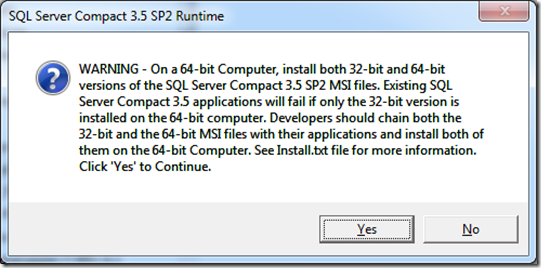

I've installed SQL Server Compact Edition 4.0 on Win7 x64 and it runs both for Asp.Net and Desktop Applications. This PC also have Visual Studio 2010 SP1 installed. But my Server 2008 R2 produces following error for Asp.Net applications, although it can run Desktop Applications: Unable to load the native components of SQL Server Compact corresponding to the ADO.NET provider of version 8482. Install the correct version of SQL Server Compact. Refer to KB article 974247 for more details.
I've tried both with a SqlDataSource and SqlCeConnection. My web.config is like below: Also tried to copy dll's as sugested but no effect. There are two ways to deploy SQL Server CE 4.0 in ASP.net. • Medium trust, or • private deployments. Your configuration file uses version 4.0.0.0 - this requires Medium Trust, and requires the App Pool user having permission to access the SQL Server Compact COM dlls in C: Program Files Microsoft SQL Server Compact Edition. Where medium trust fails, you could attempt private deployment. This is my preference and there's less chance something will go wrong with your system sometime in the future.
Selmer bundy clarinet serial number. If you private deploy the SQL Server CE DLLs, by copying all the files in v4.0 Private to bin, make sure your Web.config declare a dependency on version 4.0.0.1. This version is not deployed in the GAC and this will ensure your private copy gets loaded.
You will also require a corresponding change in the DbProvider section in Web.config.